
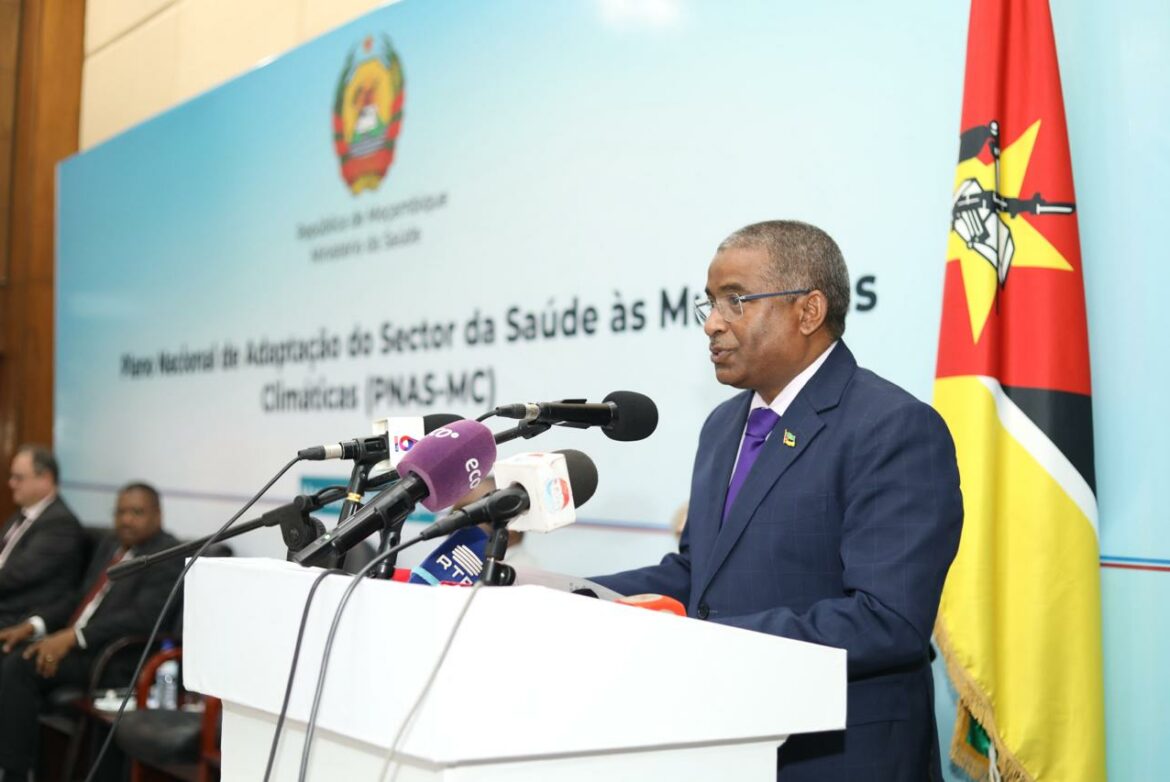
Mozambique now has a National Adaptation Plan for the Health Sector to Climate Change (PNAS-MC) for the period 2026 to 2030. The instrument was recently launched in Maputo by the Minister of Health, Ussene Isse.
This is a document developed by the National Institute of Health (INS) in partnership with the Ministry of Health, with the objective of reducing vulnerability, building resilience, and integrating health into climate policy.
On the occasion, Ussene Isse expressed his satisfaction that the instrument was produced by Mozambicans and that it represents a significant milestone in the Health sector, considering that the PNAS-MC makes Mozambique the ninth African country to have a similar plan on the continent.
“The launch of this plan represents a historic milestone in the process of building a National Health System that is resilient to climate change. In this way, our country takes an important step to protect the health of Mozambicans from the impact of climate change.
The occasion was used to announce that the ministry he directs will launch, still within this year, the Strategic Investment Roadmap for Climate and Health, a document that will define the investment needs for the aforementioned plan.
“The roadmap will also allow us to map out concrete financing opportunities and build a compelling national investment case for climate-resilient health systems,” he explained.
The Secretary of State for the City of Maputo, Vicente Joaquim, highlighted that climate change is no longer a distant threat but has become a concrete reality, with a direct impact on the health of the population. Therefore, the launch of the PNAS-MC represents a decisive milestone in consolidating a more resilient, prepared, and capable health system to respond to challenges.
The World Health Organization (WHO) Representative, Von Xylender, stated that the launch of PNAS-MC is not merely a technical act, but also a moral and political commitment to present and future generations.
“The WHO identifies eight fundamental pillars of resilience, and this plan integrates all of them, showing that the country is committed to building a robust and prepared health sector,” he stated, defending the need to create resilient health systems capable of adapting and responding effectively to climate-imposed challenges.
According to Tatiana Marrufo, Coordinator of the Health and Environment Program, including Worker's Health at INS, who was responsible for contextualizing the PNAS-MC, the instrument integrates four pillars, foresees 45 climate adaptation actions, and is budgeted at 235 million dollars.
Among the priority actions foreseen are the strengthening of health climate crisis management; reinforcement of disease early warning systems; improvement of health infrastructure; training of health professionals; strengthening of service continuity capacity during climate shocks, and climate financing for health.
The Representative for the United Nations Children's Fund (UNICEF), Maaike Arts, stated that the document is being launched in a particularly challenging context for Mozambique, as since the beginning of this year, the country has once again faced severe floods and cyclones that disrupt the lives of the population, affecting children the most, in a situation where they are the least responsible for climate change crises.
“Climate change has adverse impacts on the realization of children's rights. For UNICEF, no adaptation strategy will be fully effective if it does not place children and adolescents at the center of the climate agenda, she noted, adding that the PNAS-MC demonstrates the relevance and strategic vision of the Government of Mozambique.
For her part, the Global Fund Representative, Melissa Rodrigues, stressed that the plan demonstrates strong national leadership and, with it, Mozambique is laying the groundwork for a more resilient health system, and the Global Fund is proud to support this agenda.
Melissa Rodrigues revealed that, through the Catalytic Fund for Health and Climate, the Global Fund is investing an additional $9.5 million to strengthen the health system, making it more resilient to climate change.
The PNAS-MC launch concluded with a panel discussion on the theme “Challenges and Opportunities for Building a Climate Change Resilient Health System,” moderated by the Deputy Director General for the Scientific Area at INS, Sofia Viegas.
The panel discussion featured the Deputy National Director of Public Health, Aleny Couto, the Representative of the National Directorate of Environment and Climate Change at the Ministry of Agriculture, Environment and Fisheries, Rosália Pedro, the Representative of the Climate Finance Office at the Ministry of Planning and Development, Miranda Miguel, and the Representative of the World Bank, Ian Ford.
Various personalities participated in the event, such as the Director-General of INS, representatives from the National Institutes of Meteorology and Disaster Risk Management, the Maputo Municipal Council, among others.